
When me and my then-boyfriend-now-husband first moved from the city to a small village, I thought I’d already solved the problem. I started wearing my nicer pieces at home, such as delicate knits and pleated pants, instead of saving them for someday. It’s the advice you hear everywhere: why wait with wearing your nicer clothes for a special occasion?
For a while, it worked. I was studying and working from home, and dressing well for my own four walls felt like a small, private win. But the low-grade frustration started creeping in. I’d dress a little too nicely for a grocery run and feel out of place standing in line. Or I’d step outside (we live at the edge of a small patch of woods) and ruin a pair of good shoes in the mud within minutes.

Majah arrived, and with her came hours of walking and training every single day, rain or shine. She also turned out to be a shedder (labs are notorious for it, something we learned the hard way) and she had a habit of rubbing her face against my clothes, hooking her baby shark teeth into them, and leaving trails of fur everywhere she went.
My sleepwear, my loungewear, even the nicer pieces I wore in my little home office, all took the hit.
I started buying real activewear and outdoor gear, which helped. But I kept buying smart-casual pieces too (out of a bad habit), and the nice stuff kept outweighing the practical stuff. The imbalance dragged on until the day Majah at 4 months old ripped my second set of loungewear, but this time out in the garden when I was following her out for a pee. (She had a zoomie and randomly jumped on my legs and ripped the pants with her sharp baby teeth.)
That was the moment I realized that something had to change. I needed to rebuild my wardrobe around who I actually was now: a dog owner, living in a village, spending most of my time somewhere between the house and the woods behind it.
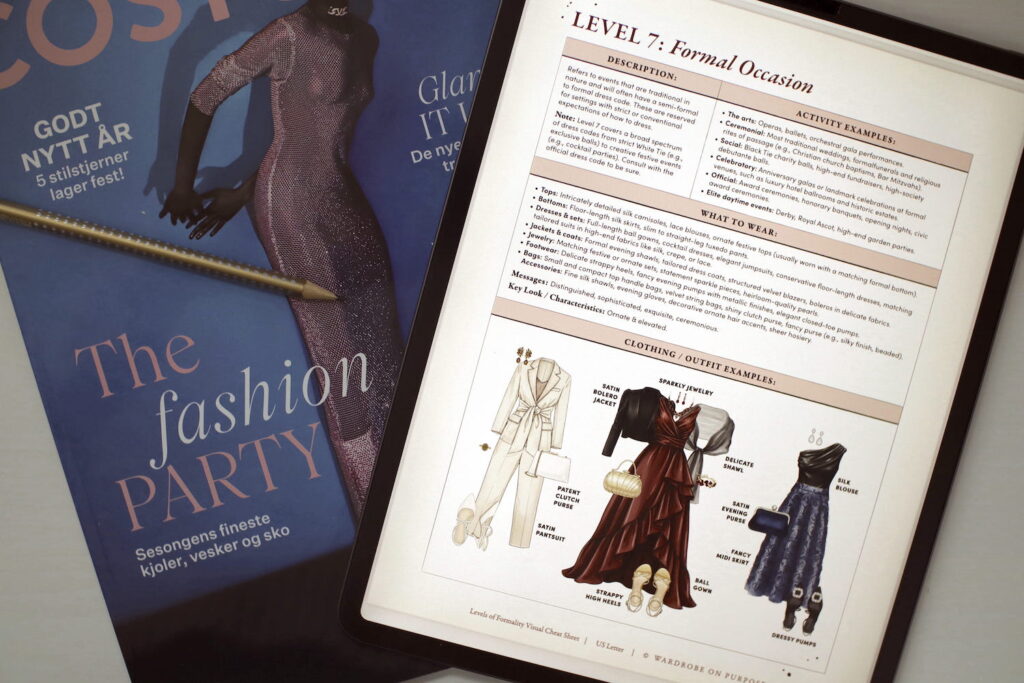
I wanted a structured, objective way to do the rebuild. And here’s the irony: I already knew how to decode a dress code. That’s the easy part when it’s someone else’s wardrobe. But for my own life, I was completely clueless. Or more honestly, in denial.
Luckily I wasn’t starting from zero. I’d already been leaning on two systems from image consultants Judith Rasband and Imogen Lamport. Rasband’s Style Scale ranks formality within professional, working contexts, everything from a casual landscaper to a corporate lawyer, but it doesn’t leave much room for ceremonial dressing, like a gala or a black-tie wedding. Lamport’s Levels of Refinement works differently again, ranking how polished a single garment is rather than what a specific activity actually calls for.
Between the two, I had good language for work clothes and for judging one piece at a time, but nothing that mapped onto my actual week. The lower levels barely got a mention at all.
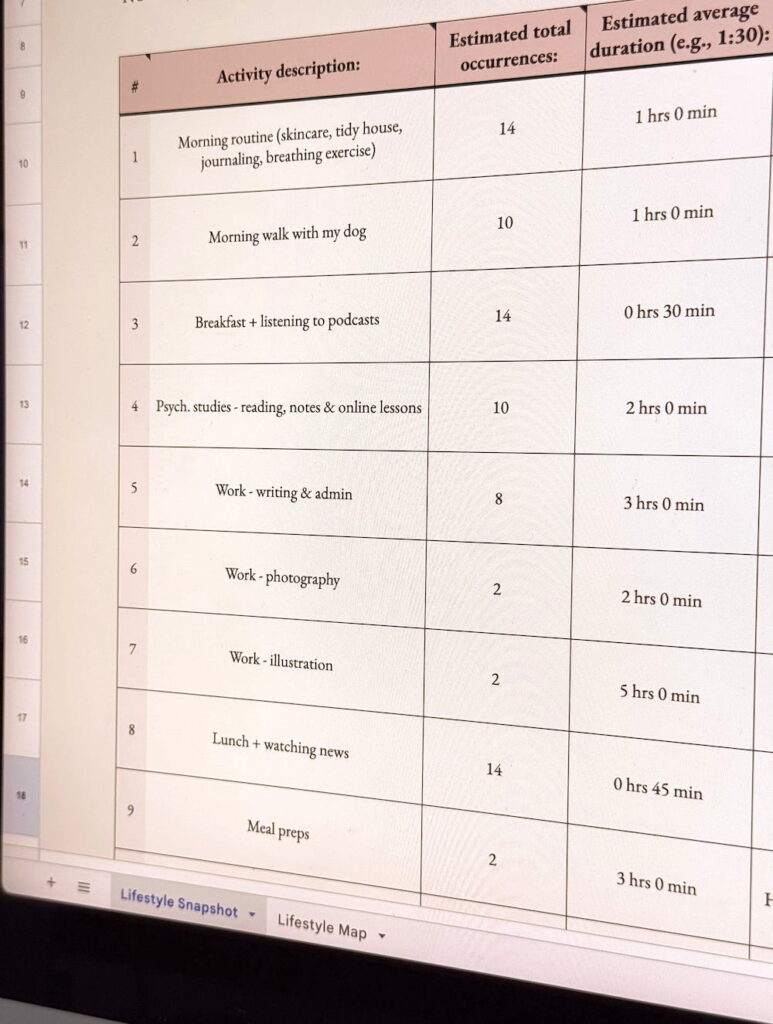
So I did what I’d tell a client to do:
I logged my days, hour by hour, to see exactly where my time actually went. It turned out I was spending about 0% at formal events and close to 35% lounging at home.
My closet, still weighted toward “nice” and “professional,” didn’t come close to reflecting that.
From that data, I built out a fuller framework, one that gave real structure to the levels most systems treat as an afterthought. I added a dedicated level for housework and rough duties. I gave activewear its own place in the system instead of folding it into “casual.”
I split loungewear from sleepwear entirely, because, as Majah had just proven, living with a puppy demands sturdier and easy to launder loungewear (plus, I didn’t want to lounge around the house and sleep in the same clothes out of hygienic reasons). And I gave formal occasions a level of their own at the very top of the scale, distinct from professional wear (think corporate suits).
Mapping my life this way made the whole picture clear and obvious.
Instead of guessing at dress expectations level by level, I could see exactly what each part of my day actually required, in a way that felt structured without being rigid. It’s more straightforward, easier to work from day to day, and it leaves room for an actual varied life instead of squeezing everything into a handful of broad categories.
At its heart, it’s a scale that classifies the functional and social expectations of any activity, so you always have something that fits.
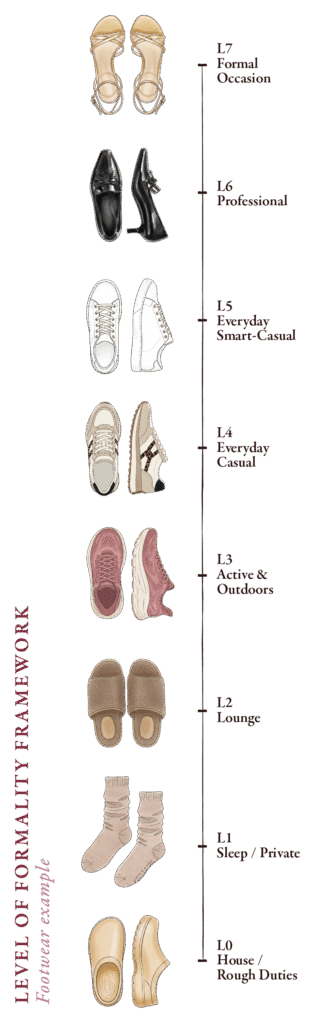
Looking at that list, you can probably already guess where most of your own week falls.
Maybe it’s obviously L4 and L5: back-to-back workdays with the occasional nice dinner thrown in. Maybe it’s mostly L2 and L3: coffee at home followed by a long dog walk. Whatever the actual shape of your week is, this is the same starting point I used. It gives you an honest look at how your hours actually get spent.
Once you can name the level, you can ask a much more useful question than “what should I buy?” You can ask “what does this actually call for?” This is exactly what helped me accept my real life and shop as well as dress with intention.
It’s not just Rasband and Lamport’s system. Most formality frameworks I’ve come across skip past these lower levels, or treat them as a footnote. It always struck me as a little bit invalidating, as if the hours you spend at home, comfortable, don’t count as real life. For most of us, they’re the majority of it.
That’s part of why I built the lower levels, L0 House/Rough Duties, L1 Sleep/Private and L2 Lounge, out fully instead of treating it as an afterthought. I remember when I first looked at my numbers, I realized how wrong I was to think that investing in clothes to wear at home wasn’t exciting.
That thinking now shapes how I organize my whole wardrobe. I have one main capsule for everyday work and study, mostly casual with a few smart-casual pieces mixed in, plus smaller, fully-built-out capsules for activewear, sleepwear, loungewear, and dressier occasions.
The framework helped the guilt and shame I felt into logic (and kind of a radical acceptance!) — and that’s where the real freedom I feel lies.